Best Rubbish Bags for Commercial Kitchens in NZ (And Why Cheap Ones Cost You More)
If you run a commercial kitchen in NZ, the rubbish bags you choose matter more than most people think. We had a call from a Thai restaurant in Wellington last month — their “heavy-duty” bags, bought from a discount warehouse, split while staff were taking out the dinner prep waste. Chicken bones went everywhere, the kitchen smelled for days, and they had to close for a deep clean. It cost them far more than the $30 they saved on cheaper bags.
Choosing the right rubbish bags for a commercial kitchen is not just about price per carton. It is about puncture resistance, council compliance, and not having to scrub your bins out every morning because the bag leaked overnight.
What “Heavy Duty” Actually Means for NZ Commercial Kitchens
Most cheap “heavy-duty” bags sit at 20–30 microns. That is fine for office waste — but in a commercial kitchen you are dealing with bones, shells, wet food scraps, and sharp edges. For kitchen waste, we recommend a minimum of 50 microns. For restaurants doing high-volume prep, 60–80 microns is the right range.
Here is a quick guide to matching microns to your kitchen type:
- 50–60 microns: Café waste and light food prep with no bones or shells. Entry-level for kitchens.
- 60–80 microns: Full commercial kitchens, restaurants, and bars. Handles bones, seafood shells, and wet waste without splitting.
- 80+ microns: Butcheries, fish markets, and high-volume meat processing. If you are handling raw protein daily, this is where you need to be.
Star-Seal vs Flat-Seal: Why It Matters for Kitchen Bags
This is one of the most overlooked specs when buying commercial kitchen rubbish bags in NZ. Flat-seal bags have a seam running along the bottom — and that seam is exactly where leaks happen when waste is wet or heavy. Star-seal bags have a gathered, reinforced base that distributes weight evenly and is far less likely to fail.
For kitchen waste — which is almost always a combination of wet, heavy, and sharp — star-seal is non-negotiable. We switched a chain of burger bars in Auckland from flat-seal to star-seal heavy-duty bags last year. Their bin cleaning costs dropped by 60% because the bags stopped leaking grease onto the bin walls.
Council Compliance and Food Waste Rules in NZ
Most NZ councils now require separate food waste collection for commercial businesses, and the rules around bag type are specific. Auckland Council’s commercial food scraps service requires certified compostable bags — not just any bag labelled “biodegradable.” We have seen businesses fined for using bags that were not certified to the correct standard.
If you are in Wellington, Christchurch, or any major NZ city, check your council’s current rules. As a general guide:
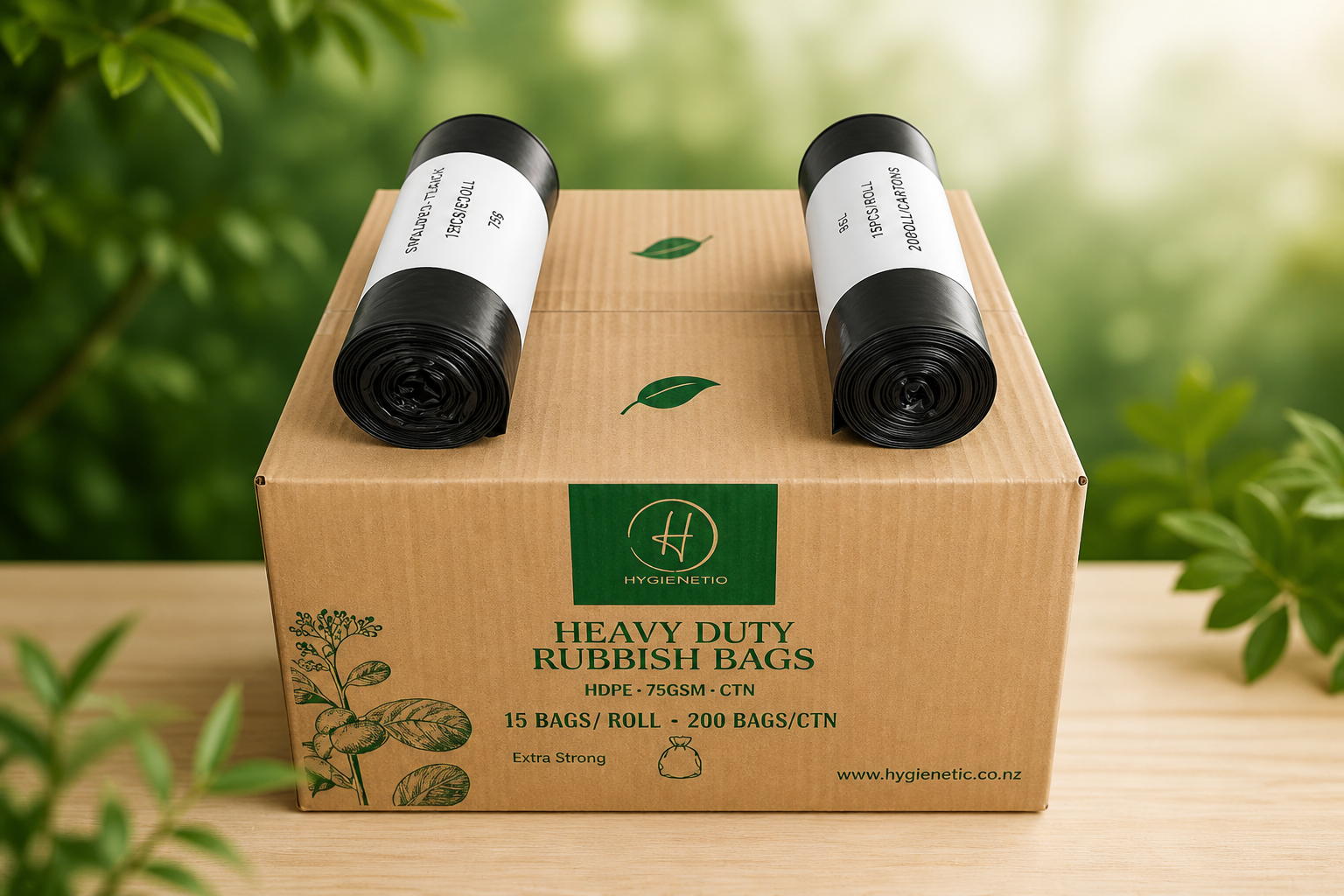
- General waste: Standard heavy-duty black bags are acceptable — like our Hygienetic Heavy Duty Black Rubbish Bags 80L or 120L.
- Food scraps and organics: Must be certified compostable — look for the seedling logo or AS/NZS 4736 certification.
- Recycling: Clear bags only — coloured bags are not accepted in most NZ council recycling streams.
Sizing Your Rubbish Bags for Commercial Kitchen Bins
Two sizing mistakes come up repeatedly. The first is bags that are too small — they fall into the bin and waste ends up directly on the bin walls. The second is bags that are too large — staff spend time wrestling with excess plastic that bunches up and makes the bin harder to use. Measure your bin’s internal dimensions first, then match to litre capacity. Most commercial kitchen bins sit in the 80L–120L range, which is exactly why we stock both sizes.
One practical tip: if your bin has a foot pedal lid, make sure the bag is at least 10cm taller than the bin height. That extra length gives enough material to tie off cleanly without the weight of the waste pulling the bag down and popping the lid open mid-shift.
The Real Cost of Cheap Rubbish Bags
It is easy to look at a $40 carton of warehouse bags and feel like you are saving money. But when a bag splits inside a kitchen bin, the actual cost adds up quickly:
- 30 or more minutes of staff time to clean up
- Bin cleaning chemicals and additional labour
- Odour issues that can affect your food safety rating
- Pest risk if waste leaks into the bin area or floor drain
Our Heavy Duty Black Rubbish Bags 80L and 120L are built specifically for commercial kitchen demands. For most kitchens, the price difference between a quality heavy-duty bag and a cheap warehouse alternative is a few cents per bag — far less than the cost of one split bag during a busy dinner service.
At Hygienetic, we supply heavy-duty kitchen bags and clear recycling bags to commercial kitchens across NZ. Get in touch and we can have a sample pack to your kitchen within two business days — so you can test them properly before committing to a bulk order.